Physical Address
304 North Cardinal St.
Dorchester Center, MA 02124
Physical Address
304 North Cardinal St.
Dorchester Center, MA 02124

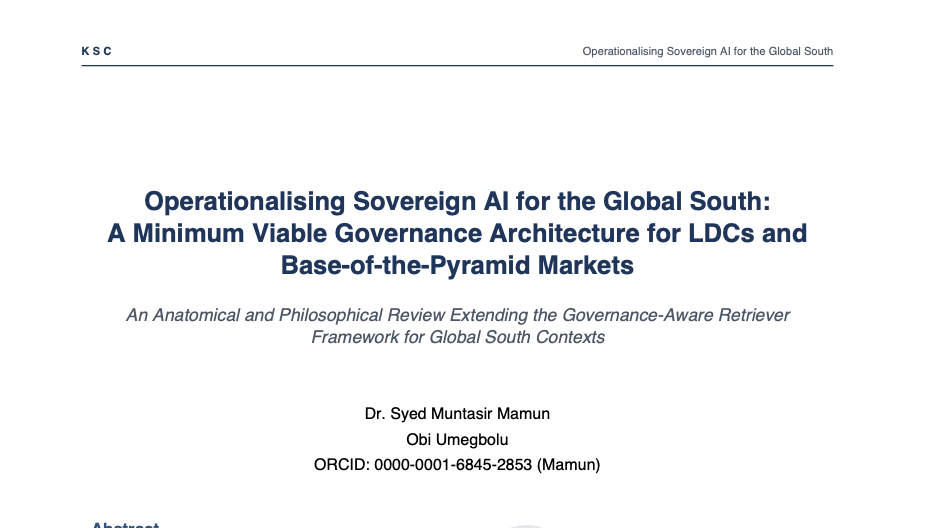
As governments across the Global South seek to harness artificial intelligence for public service delivery and economic development, the challenge is no longer simply whether AI should be adopted but how it can be deployed in ways that preserve national autonomy, strengthen institutions, and reflect local realities. This paper examines that challenge through the lens of sovereign AI.
Recognising that full technological sovereignty remains beyond the immediate reach of many Least Developed Countries (LDCs) and Base-of-the-Pyramid (BoP) economies, the paper proposes a practical Minimum Viable Governance Architecture (MVGA). Rather than relying on expensive infrastructure or complete technological independence, the framework combines governance safeguards, locally curated knowledge, open technologies, and agile institutional approaches to support responsible AI adoption within existing resource constraints.
The paper explores how the Governance-Aware Retriever Framework (GnARF) can be adapted for African and Global South contexts through the use of Minimum Viable Innovation Engines (MVIEs), enabling governments to reduce vendor dependence, improve transparency, strengthen local knowledge systems, and build institutional capacity incrementally. It also examines the opportunities, trade-offs, and broader philosophical implications of embedding AI systems within diverse cultural, legal, and governance environments.
Developed as a contribution to international discussions on AI governance, the paper offers practical considerations for policymakers, public institutions, researchers, and development partners working to advance AI sovereignty while promoting inclusive and context-sensitive governance across the Global South.
Download the full paper via the link below.