Physical Address
304 North Cardinal St.
Dorchester Center, MA 02124
Physical Address
304 North Cardinal St.
Dorchester Center, MA 02124

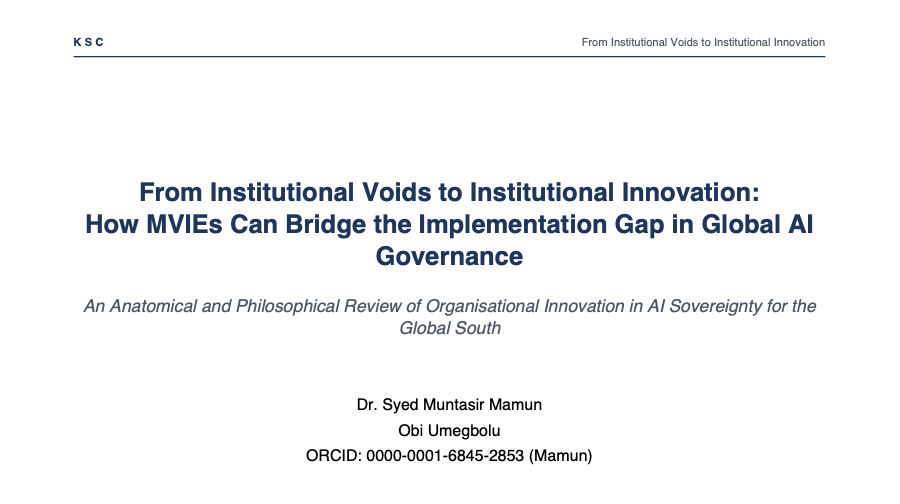
As countries across the Global South continue to develop AI strategies and governance frameworks, one of the most persistent challenges remains turning policy ambitions into practical implementation. This paper explores how institutional innovation can help bridge that gap by focusing on the organisational capacity required to operationalise responsible AI governance.
The paper argues that institutional constraints should not be viewed solely as obstacles but also as opportunities for innovation. It introduces Minimum Viable Innovation Engines (MVIEs) as lightweight, cross-functional public-sector teams designed to help governments experiment with AI solutions, strengthen institutional learning, and gradually build sovereign AI capabilities within existing administrative and financial realities.
Building on the Governance-Aware Retriever Framework (GnARF), the paper examines how MVIEs can connect citizen needs, locally curated knowledge, appropriate technologies, and governance processes to support transparent and context-aware AI deployment. It also evaluates the advantages and limitations of this organisational model while considering its implications for public administration, local knowledge systems, and the long-term development of AI governance in Africa and the wider Global South.
Prepared as a contribution to ongoing international discussions on AI governance, the paper provides practical recommendations for governments, policymakers, development organisations, and researchers seeking to strengthen implementation capacity while ensuring that AI systems remain accountable, locally relevant, and institutionally sustainable.
Download the full paper via the link below.